

History of Blackjack is one of the many enigmas in the realm of gambling. No one knows for sure where or when it originated. Some suspect that it was originally developed in France under the name Vingt-et-Un (which translates as 21) somewhere in the 18th century. Others say that it began as a Spanish game known as One and Thirty, in this version the goal was to score 31 with a minimum of three cards. Some go even to say that a similar game was played in ancient Rome, where gambling was particularly popular as there were no government regulations or religious prosecutions of any sort. Only the Roman version was played with small numbered wooden pieces rather than with cards.
Similarly to folklore, gambling was developing inside different cultures and lived through countless iterations throughout centuries before it became a unified industry that we all know today. Blackjack is just one example of it.
Modern Times
The biggest growth in the game’s spread took place during the colonization of the New World by French. Soon after Europeans spread out, it was played along the entire continent of North America. But the biggest explosion in popularity happened in 1931 in Nevada when gambling was legalized, this was the inception of Las Vegas as the world capital of gambling.
But even then there were some variations in the rules that would be either adopted or rejected. For example, in one version having Ace of Spades with five of Clubs would play 10 to 1. This started because of the famous gambler who has won $10,000 with those cards. And back then the currency exchange rate was much different, so this amount of money was considered to be a true fortune.
Subtract Divide Repeat
But the most interesting thing about Blackjack is probably the counting of cards. Yes, we all heard of it, but how many of you really know what that means? Well, allow me to explain it in the simplest way I can.
With the use of early computers, Edward O. Thorp analyzed different probabilities of keeping track of cards and getting the edge over the house, which was unheard of without cheating back then and it’s still something out of the ordinary today. He then published his work in a book called Beat the Dealer in 1962. Such was the beginning of card counting. Surprising, isn’t it? You would think that for a game that’s been around for centuries someone would come up with it a bit quicker. Someone might have, but they hadn’t popularized or recorded it, so the credit goes to Thorp.
The ten-count system as it is known is not the easiest to practice. You take two numbers 16 and 36, they represent the so called tens and other cards. So what you should do…
You need to calculate the ratio by counting backwards as the tens and others go along and divide the new number of others by the number of tens. Up until you’ve reached the ratio that puts you in a winning probabilistic position, at which point you play big. Sounds easy, just a little bit of practice and you can do it. Good luck to do so in an 8-deck game.
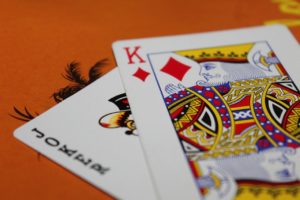
But here is the thing, it worked. The same year the book was published it reached bestselling numbers and Vegas suffered quite a bit from the flow of gamblers with good memory and basic mathematical skills.
But quite soon the casinos took a no-counting policy. I know what you all thought. I’ve seen those movies myself. No gangster staff (perhaps it was the thing for a little while in underground casinos) – in reality, today’s casinos just ask you to leave and refuse services in the future.
But that’s all for today. I hope you’ve learned something new. Stay tuned, because in the following articles we will discuss various Blackjack strategies that you can utilize. But for now, how about getting some practice with some of our bonuses at HotPotBonus?